Showing posts with label copyright. Show all posts

Wednesday, August 07, 2024

Copyright and AI

“AI raises fundamental questions for copyright law and policy, which many see as existential. To what extent will AI-generated content replace human authorship? How does human creativity differ in nature from what AI systems can generate, now or in the future? What does this mean for the incentive-based foundation of the U.S. copyright system? In what ways can the technology serve as a valuable tool to amplify human creativity and ultimately promote science and the arts? How do we respect and reward human creators without impeding technological progress?” 
                                         Shira Perlmutter, Register of Copyrights 


Because of the disruptive nature (i.e., an innovation that significantly alters the way that consumers, industries, or businesses operate) of AI generated materials, the US Copyright Office has been studying the effects of AI on the role of copyrights and devising policies and procedures for dealing with those effects. 

On March 16, 2023 the Copyright Office launched the New Artificial Intelligence Initiative to address, among other things, the copyrightability of works produced by AI and the use of copyrighted materials in creating data sets that “train” generative AI, which they define as “an application of AI used to generate outputs in the form of expressive material such as text, images, audio, or video. Generative AI systems may take commands or instructions from a human user, which are sometimes called ‘prompts.’” 

In August of 2023, the Copyright Office published in The Federal Register a Notice of Inquiry requesting comments and information from the public addressing these issues. Comments were accepted through December 6, 2023. 

From their study, which will incorporate these public comments and information, the Copyright Office intends to publish their report Copyright and Artificial Intelligence which will make recommendations for policies within the Copyright Office and to Congress for establishing copyright laws. 

On July 31, 2024, the Copyright Office published the first part of the report, Part 1: Digital Replicas. This first part of the report deals with the proliferation of videos, images, and audio recordings that “digitally created or digitally manipulated to realistically but falsely depict an individual.” The report concluded that these unauthorized replicas threaten the entertainment industry, the political arena, and private individuals. It recommends Congress pass laws for protection from these replicas and defines the scope these laws should take in reference to “what kinds of replicas it should cover, whom it should protect, the term of protection, liability, licensing and assignment, First Amendment concerns, potential remedies, and the statute’s relationship to state law.” The recommendations do not include protections for an artist’s “style.” 

No dates have been announced yet for the forthcoming parts of the Report. One can follow the progress of the study and the reports on the Copyright Office AI webpage.

Thursday, April 07, 2022

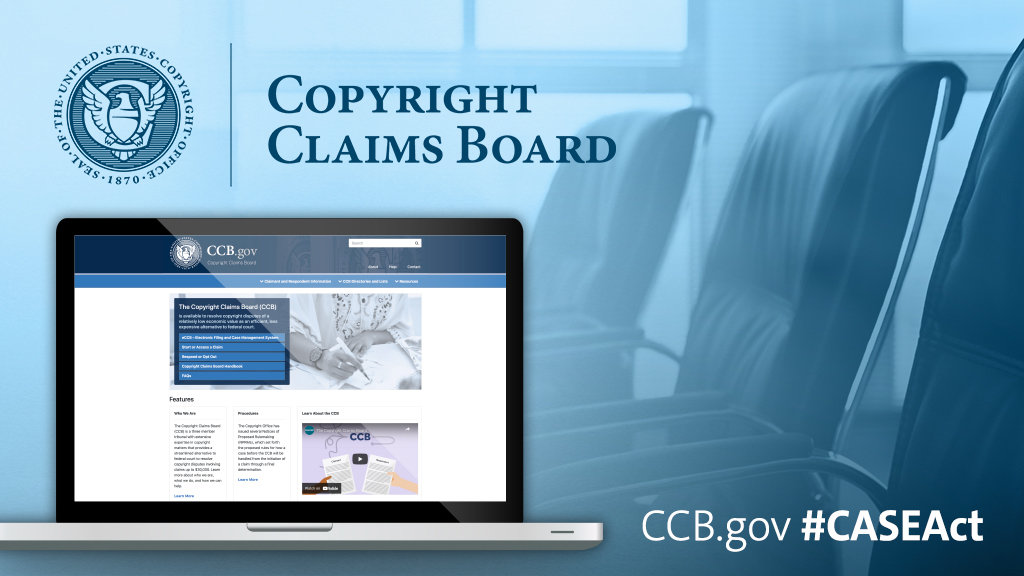
Copyright Office Launches New Copyright Claims Board Website


CASEActSocMed2022_CCBdotgov_Board 

Today, April 7, 2022, the U.S. Copyright Office launched ccb.gov, a website serving as a gateway to the first copyright small-claims tribunal in the United States, the Copyright Claims Board (CCB). The launch of ccb.gov is a major milestone toward the full opening of the CCB to creators and users of copyrighted materials later this spring.

The website is the new online home of the CCB and is focused on helping everyone understand the mission and the processes of the CCB. Once the CCB starts hearing claims later this spring, ccb.gov will become the primary location for information about filing and responding to claims, opting out of a proceeding, accessing the CCB’s Handbook, and contacting the CCB with questions.

The new website features clear, helpful information about the CCB, including what potential claimants and respondents need to know about CCB proceedings. The website will also host the CCB’s Designated Service Agent Directory, the list of libraries and archives that have preemptively opted out of CCB proceedings, and updates on the status of CCB-related rulemakings.

The CCB’s Designated Service Agent Directory is a public directory in which corporations, partnerships, and unincorporated business entities can designate an individual to receive service of the initial notices of all proceedings and claims asserted against them before the CCB. The directory is now accepting submissions and will be regularly updated. Please note that this directory is different from the existing section 512 designated agent directory under the Digital Millennium Copyright Act (DMCA).

The CCB’s Libraries and Archives page will feature a public list of the libraries and archives that have preemptively opted out of CCB proceedings. A form for libraries and archives to preemptively opt out is now available on ccb.gov, and the list of libraries and archives, when compiled, will be regularly updated. A library’s or archives’ opt-out election also covers those entities’ employees acting within the scope of their employment.

Please bookmark ccb.gov for future reference.

Thursday, April 30, 2015

New Fair Use Index from the U.S. Copyright Office

The U.S. Copyright Office has created a Fair Use Index "to make the principles and application of fair use more accessible and understandable to the public by presenting a searchable database of court opinions, including by category and type of use (e.g., music, internet/digitization, parody)." It includes a wide selection of cases regarding fair use (but not all) and is not a substitute for legal advice. Each decision includes "a brief summary of the facts, the relevant question(s) presented, and the court’s determination as to whether the contested use was fair." Browse all the cases, search for specific cases or review cases from specific courts. Usually only the highest court decision issued in a case is included. The index does not include the court opinions themselves, but provides citations to access those opinions through other free (Google Scholar, Justia, etc.) or commercial databases (Westlaw, LEXIS, etc.).

Tuesday, February 24, 2015

Fair Use Week, Feb. 23-27, 2015

ARL, the Association of Research Libraries, is coordinating a celebration of Fair Use Week from February 23-27, 2015. ARL states:

[Fair Use Week] celebrates the important role fair use plays in achieving the Constitutional purpose of intellectual property rights in the US: to promote the progress of science and the useful arts. The flexible nature of the fair use doctrine has permitted copyright to adapt to new technologies and changes.

Information about ways to participate in Fair Use Week are available from http://www.fairuseweek.org  and from ARL.

Wednesday, August 20, 2014

New Copyright Publication

The U.S. Copyright Office has made available for viewing a public draft of the Compendium of U.S. Copyright Office Practices, Third Edition, the first major revision in more than two decades. According to the announcement,
the draft presents more than 1200 pages of administrative practices and sets the stage for a number of long-term improvements in registration and recordation policy. It will remain in draft form for 120 days pending final review and implementation, taking effect on or around December 15, 2014.
More information and a link to download the draft is available at http://copyright.gov/comp3/.

For previous editions see The Compendium of U.S. Copyright Office Practices, First Edition (1973) and Second Edition (1984).

Thursday, November 03, 2011

Digital Goods and Copyright

In copyright law the first sale doctrine gives someone who purchases a copyrighted work the right to sell or dispose of it without getting permission from the copyright holder.  However, according to law professor Annemarie Bridy, regarding digital products " it will increasingly be the case that consumers do not own the information goods they buy (or, rather, think they've bought)." In The Digital Death of Copyright's First Sale Doctrine she reveals that on October 3 the Supreme Court refused to review Vernor v Autodesk, a Ninth Circuit Court of Appeals decision about whether the first sale doctrine applied to transactions involving software and other digital information goods. She concludes:
Under the court's decision in Vernor, all a copyright owner has to do to effectively repeal the statutory first sale doctrine is draft a EULA that (1) specifies that the user is granted a license; (2) significantly restricts the user's ability to transfer the software; and (3) imposes notable use restrictions.
See her article linked above for the full discussion.

Thursday, April 05, 2007

Copyright Renewal Database

Orphan works, books printed between 1923 and 1963 that have no apparent owner, cause real problems for institutions that want permission to digitize titles. Now Stanford University has created the Copyright Renewal Database to make it easier to identify orphans. The database consists of renewal records received by the U.S. Copyright Office between 1950 and 1993 for books published between 1923 and 1963. Be forewarned, however, that it only covers renewals (not original registrations) of books (Class A registrations) that were published in the United States.