Tuesday, April 16, 2024
Big News! Federal race & ethnicity collection standards have CHANGED
Monday, January 22, 2024
No More Driving With Cake
You’ve probably seen a recent meme on Facebook directing
drivers that, because of current winter conditions, they should “drive with
cake.” Or you’ve seen some of the Texas
road signs such as “Only Rudolph Should Drive Lit” or “The Eyes of Texas Are
Upon You, Buckle Up.” These types of signs
have been created by both the Texas Department of Transportation and/or the
U.S. Department of Transportation to encourage drivers to be careful driving on
state and federal highways. However, soon you will no longer be able to see these
signs. In the recently updated manual of
the U.S. Federal Highway Administration , guidelines were published banning
them. Electronic signs with
"obscure meanings, references to pop culture or those intended to be
funny" are required to be phased out within the next couple of years and
all signs must be "simple, direct, brief, legible and clear," to
"relay important information."
These changes were released by the U.S. Department of Transportation
on December 19, 2023 and published in the Federal Register on the same
day. (The Federal Register daily publishes
changes to the U.S. Code of Federal Regulations.) The regulations went into effect on January
18, 2024.
Although these new regulations may make your driving
experience less entertaining, the Houston Chronicle has reported that when
electronic traffic signs report information other than current traffic situations
or weather conditions, such as the number of fatalities on Texas roads up to a
certain date, risk of traffic accidents increases.
Wednesday, January 10, 2024
GovInfo Reaches Record Number of Hits
Since 1994 the Government Publishing Office or GPO (formerly the Government Printing Office) has been providing trustworthy government information online for free to anyone. The GPO is a government agency falling under the legislative branch of government and by law provides free access to government documents produced by all three branches of government. Until the onset of electronic access, the only way to accomplish this was through the Federal Depository Library Program whereby documents are sent to designated government libraries across the country. Now, in conjunction with the FDLP, government information is widely available online through the site GovInfo.gov.
Last year a record number of 1.15 billion retrievals were accessed through GovInfo. This is an
increase of 32% over 2022 and an increase of 215% over 2018! The most popular
source of information in 2023 was the Federal Register (the Federal Register is
a daily compilation of documents produced by the Executive branch including
changes to federal regulations, notices from federal agencies, executive orders
and other presidential documents).
The GPO’s electronic dissemination of information began in
1994 with the creation of GPOAccess. In
2009 the next generation system, the Federal Digital System (FDsys), was introduced. In 2016, the current site GovInfo was
launched. But the GPO is not only
assigned the duty of spreading government information; it is also given the responsibility
to preserve government documents for future posterity, including those
documents born digital. In 2019 GovInfo
was the first US digital depository, and the second in the world, to be certified
as having the “highest global standard of excellence possible” in providing access
and preservation to these important materials.
Tuesday, October 31, 2023
Census Bureau Seeks Comments on the American Community Survey
Beginning in 1810, the third census taken by the United States, the Census Bureau, a sub-agency within the Department of Commerce, understood that more information was needed about the public than the basic questions supplied. This information was needed by business owners and potential business owners, academics doing research, other government agencies, etc. Questions were added to the census covering various topics such as agriculture, industry, and commerce, as well as individuals' occupation, ancestry, marital status, disabilities, place of birth, and other topics. These questions became unwieldy for the overall population, so in 1940, the Bureau created the long-form census questionnaire, which was sent to a random sampling of citizens. More recently, the Bureau discovered that people need more up to date data than was provided by the decennial census. In order to collect social, economic, and housing data continuously, the Bureau implemented, in 2005, the American Community Survey (ACS) and the Puerto Rico Community Survey (PRCS). This survey eliminated the need for the long-form of the census.
Periodically, the Census Bureau tests the
questions to see if question wording, instructions, response categories,
and underlying constructs need to be changed.
They also make changes to current topics or add topics as needed. Current topics include household roster,
educational attainment, health insurance coverage, disability, and labor force
questions. Three new topics are proposed
for the 2025 census – solar panels, electric vehicles, and sewage disposal.
These changes and new topics will be available in the 2025 ACS/PRCS. The Department of Commerce/Census Bureau is seeking comments on these changes and additions as well as on the validity of how questions are asked and the methodology of gathering and analyzing the information. They are also asking for comments on how to make the survey less burdensome and more efficient for the respondents.
In order to read the document and make a comment, go to https://www.federalregister.gov/documents/2023/10/20/2023-23249/agency-information-collection-activities-submission-to-the-office-of-management-and-budget-omb-for
Comments must be received on or before December 19, 2023.
The Census Bureau warns “comments that you submit in
response to this notice are a matter of public record. We will include, or
summarize, each comment in our request to OMB (Office of Management and Budget)
to approve this ICR (Information Collection Request). Before including your
address, phone number, email address, or other personal identifying information
in your comment, you should be aware that your entire comment—including your personal
identifying information—may be made publicly available at any time. While you
may ask us in your comment to withhold your personal identifying information
from public review, we cannot guarantee that we will be able to do so.”
Monday, April 16, 2018
GPO Completes Digitizing all Issues of the Federal Register
The U.S. Government Publishing Office (GPO) and the National
Archives’ Office of the Federal Register (OFR) have digitized every
issue of the
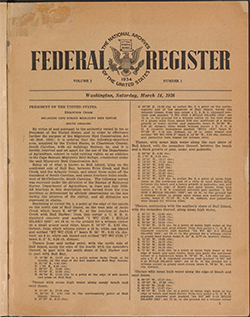
Federal Register, dating back to the first one published in 1936. A
total of 14,587 individual issues, which is nearly two million pages,
has
been digitized.The complete Federal Register from 1936 to the present is now available digitally on GPO’s govinfo. https://www.govinfo.gov/app/collection/FR .
Some highlights from the early issues of the Federal Register:
- The first Executive Order published in the Federal Register on March 14, 1936, enlarged the Cape Romain Migratory Bird Refuge in South Carolina.
- The first war related Presidential proclamations following the Declaration of War on Japan was published in the December 10, 1941 Federal Register issue.
- The August 25, 1958 issue contains the Executive Order outlining changes to the flag following the admittance of Hawaii as a state.
“We are proud to announce the completion of a long-awaited goal - digitization of the entire set of Federal Registers that were not "born digitally" before 1994. With the release of the final set of books, GPO and the OFR have made a great leap in providing public access to an important collection of 20th Century Federal Government documents,” said OFR Director Oliver Potts.
The first issue of the Federal Register came off GPO presses on March 14, 1936. President Franklin D. Roosevelt issued the first document, an Executive Order, to be published. The Federal Register is the official daily publication for rules, proposed rules, and notices of Federal agencies and organizations, as well as Executive Orders and other presidential documents. It is updated daily by 6 a.m. and is published Monday through Friday, except Federal holidays, in both digital and print editions.
Wednesday, February 14, 2018
GPO Issues Digital Release of Federal Register for the 1960s
- The first executive order of the Kennedy administration expanded food aid to needy families: January 24, 1961
- Proclamation by President Johnson of a national day of mourning for President Kennedy: November 27, 1963
- Notice of an establishment of a quarantine period for extraterrestrial exposure for the astronauts on the Apollo 11 space mission: July 25, 1969
Monday, December 23, 2013
FDA Food Safety Proposed Rule
More information is available from the FDA News & Events page or from the proposed rule.