Showing posts with label census. Show all posts

Thursday, July 24, 2025

New 2024 Survey of Income and Program Participation (SIPP) data released


JULY 24, 2025 — The U.S. Census Bureau today released data from the 2024 Survey of Income and Program Participation (SIPP) detailing the income and assistance program participation of individuals and households in the United States.

The SIPP is a longitudinal survey, one that collects data from the same individuals over an extended period of time and measures changes in characteristics like economic well-being, family dynamics, education, assets, health insurance, child care, and food security. 


Thursday, December 19, 2024

The Power of Expertise: The Census Bureau Welcomes New Census Scientific Advisory Committee Members

 The U.S. Census Bureau recently announced the appointment of five new members to its Census Scientific Advisory Committee (CSAC). These distinguished professionals bring diverse expertise from fields like sociology, economics, disability research, and computer sciences to tackle critical challenges in census operations and data management.

Meet the New CSAC Members

The new appointees include:

Kristine J. Ajrouch: Research professor at the University of Michigan, focusing on group dynamics.

Sara Curran: Professor at the University of Washington with expertise in international studies, sociology, and public policy.

Andrew J. Houtenville: Economics professor and director of the Institute on Disability at the University of New Hampshire.

Bonnielin K. Swenor: Endowed professor of Disability Health and Justice and director of the Disability Health Research Center at Johns Hopkins.

Jonathan Ullman: Associate professor at Northeastern University's Khoury College of Computer Sciences.

These new members will help shape the future of census programs, policies, and operations.

Why the Census Scientific Advisory Committee Matters
The Census Scientific Advisory Committee (CSAC) was established to address emerging challenges in census operations, including adaptive design, cybersecurity, and statistical research. The committee also provides guidance on the application of scientific advancements in various fields like
:

  • Survey methodology
  • Geospatial and statistical analysis
  • Cognitive psychology
  • Econometrics
  • Business operations
  • Computer science

CSAC’s insights influence many aspects of Census Bureau activities, ensuring data accuracy and operational efficiency.


A Rich History of Advisory Excellence

The Census Bureau’s advisory tradition dates back to 1994 with the formation of the Census Advisory Committee of Professional Associations (CACPA). Re-chartered as CSAC in 2010, the committee now comprises up to 21 members from diverse disciplines.


CSAC has been instrumental in guiding landmark Census Bureau programs, including the decennial census, demographic studies, and economic surveys. The committee’s recommendations have shaped data collection techniques, statistical accuracy, and the accessibility of information for public use.


Accessing Census Bureau Information

The Census Bureau values transparency and public engagement. Access key materials from past CSAC meetings, including agendas, minutes, public comments, and recordings, to learn more about their work and recommendations. Stay informed about future meetings of the 2030 Census Advisory Committee. Meeting dates, agendas, and materials are regularly updated on the Census Bureau website.

  • Access the meeting agenda, meeting minutes, public comments and meeting recordings: 
    2024

Take a moment to explore the wealth of knowledge and resources available to us through their groundbreaking efforts.

[By Anna Xiong, Kelley Center]

Monday, July 22, 2024

Hot Enough For Ya?

July and August are the hottest months of the year, with September not far behind here in the South.  Extreme high heat can affect our outdoor activities, our electric bills, and our moods.  But what effect does heat have on the most vulnerable communities and what is their resilience to this external pressure on them.  According to the Census Bureau, “Community resilience is the capacity of individuals and households within a community to absorb the external stresses of a disaster.”

The United States Census provides data about the population in numerous topic areas.  Most recently (July 16, 2024), they released their report on the 2022 Community Resilience Estimates (CRE) for Heat.  The report includes Quick Guide which can be used to understand and use the data available.  The Bureau previously released data for 2019.

In general, the CRE reports the social vulnerability that inhibits community resilience.  The CRE for Heat (which is an experimental report) adds new components of social vulnerability and information concerning exposure.  For example, the report looks at which areas (by geography, state, county, and census tract) have more than two days in a row of temperatures over 90 degrees and what households in those areas do not have air conditioning. 

The CRE for Heat uses information from the American Community Survey and the Population Estimates Program.  The American Community Survey is conducted every month of every year and, unlike the decennial census, is sent to a sample of addresses.  The survey asks questions about topics not in the regular census such as education, employment, internet access, and transportation. 

The Population Estimates Program annually produces reports on the estimated changes in population and housing units for the nation, states, counties, cities and towns and includes births, deaths, and migrations. 

Arizona State University’s Knowledge Exchange for Resilience collaborates with the Census Bureau to produce the CRE for Heat reports.

The data from the CRE for Heat is included in My Community Explorer which is a Census Bureau tool to identify underserved communities and includes Census Bureau and Emergency Response datasets. 

Tuesday, October 31, 2023

Census Bureau Seeks Comments on the American Community Survey

 Beginning in 1810, the third census taken by the United States, the Census Bureau, a sub-agency within the Department of Commerce, understood that more information was needed about the public than the basic questions supplied.  This information was needed by business owners and potential business owners, academics doing research, other government agencies, etc.  Questions were added to the census covering various topics such as agriculture, industry, and commerce, as well as individuals' occupation, ancestry, marital status, disabilities, place of birth, and other topics.  These questions became unwieldy for the overall population, so in 1940, the Bureau created the long-form census questionnaire, which was sent to a random sampling of citizens.  More recently, the Bureau discovered that people need more up to date data than was provided by the decennial census.  In order to collect social, economic, and housing data continuously, the Bureau implemented, in 2005, the American Community Survey (ACS) and the Puerto Rico Community Survey (PRCS). This survey eliminated the need for the long-form of the census.

Periodically, the Census Bureau tests the questions to see if question wording, instructions, response categories, and underlying constructs need to be changed.  They also make changes to current topics or add topics as needed.  Current topics include household roster, educational attainment, health insurance coverage, disability, and labor force questions.  Three new topics are proposed for the 2025 census – solar panels, electric vehicles, and sewage disposal.

These changes and new topics will be available in the 2025 ACS/PRCS.  The Department of Commerce/Census Bureau is seeking comments on these changes and additions as well as on the validity of how questions are asked and the methodology of gathering and analyzing the information.  They are also asking for comments on how to make the survey less burdensome and more efficient for the respondents.

In order to read the document and make a comment, go to https://www.federalregister.gov/documents/2023/10/20/2023-23249/agency-information-collection-activities-submission-to-the-office-of-management-and-budget-omb-for

Comments must be received on or before December 19, 2023.

The Census Bureau warns “comments that you submit in response to this notice are a matter of public record. We will include, or summarize, each comment in our request to OMB (Office of Management and Budget) to approve this ICR (Information Collection Request). Before including your address, phone number, email address, or other personal identifying information in your comment, you should be aware that your entire comment—including your personal identifying information—may be made publicly available at any time. While you may ask us in your comment to withhold your personal identifying information from public review, we cannot guarantee that we will be able to do so.”


Thursday, May 04, 2023

Access USA Trade Online Data / Census Bureau

Today's Government Information for Research blog features USA Trade Online by Census Bureau. What is it? USA Trade® Online is a free, simple, and fast way to access the monthly merchandise trade numbers.
Click here to find an example that shows data for five commodity numbers, covering three years, with a list of countries, for either imports or exports. It provides step by step instruction on how to do it. If you need further help and assistance about searching, accessing, and using this government data resource, please email govhelp@rice.edu.

Thursday, March 24, 2022

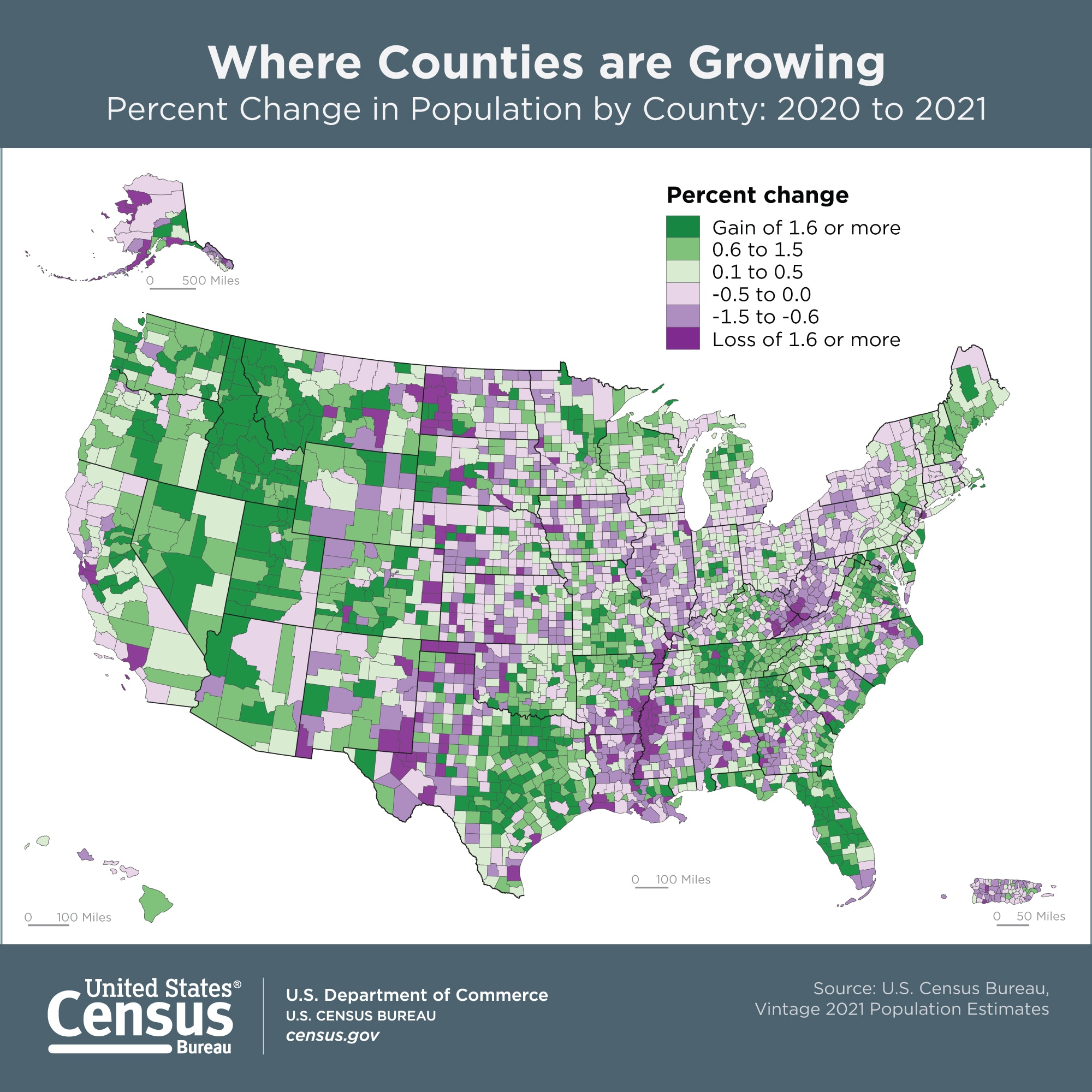
Over Two-Thirds of the Nation’s Counties Had Natural Decrease in 2021


Over Two-Thirds of the Nation’s Counties Had Natural Decrease in 2021

Pop Estimates Census.gov Hero
https://www.census.gov/content/dam/Census/library/visualizations/2022/comm/where-counties-are-growing.jpg

COVID-19 pandemic's impact on births and deaths results in a record number of counties experiencing natural decrease

MARCH 24, 2022 — More than 73% (2,297) of U.S. counties experienced natural decrease in 2021, up from 45.5% in 2019 and 55.5% in 2020, according to the U.S. Census Bureau’s Vintage 2021 estimates of population and components of change released today. Natural decrease occurs when there are more deaths than births in a population over a given time period.

In 2021, fewer births, an aging population and increased mortality – intensified by the COVID-19 pandemic – contributed to a rise in natural decrease. The statistics released today include population estimates and components of change for the nation’s 384 metropolitan statistical areas, 543 micropolitan statistical areas and 3,143 counties.  


Read More

Wednesday, September 22, 2021

Census Academy: New 2020 Census Redistricting Resources Available

 Census Academy: New 2020 Census Redistricting Resources Available

The Comprehensive Course for Accessing 2020 Census Redistricting Data

If you are interested in exploring 2020 Census redistricting data, check out Census Bureau's new all-level course.

It teaches you the basics about the Decennial Census, the Redistricting Data Program, Public Law 94-171 redistricting data, geographic availability, and the legacy format. You will then learn about the available sources to access these data and the features of each source.

Select one or more learning pathways to learn how to access data from the Census File Transfer Protocol (FTP), data visualizations, data.census.gov, and the Census Application Programming Interface (API).
Learn More (https://www.census.gov/data/academy/courses/comprehensive-course-for-accessing-2020-census-redistricting-data.html?utm_campaign=20210922mscacs1ccstors&utm_medium=email&utm_source=govdelivery)

How Can I Access 2020 Census Redistricting Data

There are a few ways that you can access 2020 Census redistricting data for your area. Discover three valuable resources and learn when to use one tool over others in this video tutorial.
Learn More
https://www.census.gov/data/academy/data-gems/2021/how-to-access-2020-census-redistricting-data.html?utm_campaign=20210922mscacs1ccstors&utm_medium=email&utm_source=govdelivery

Visit updated Census Academy 2020 Census page to find more helpful resources: https://www.census.gov/data/academy/topics/2020-census.html?utm_campaign=20210922mscacs1ccstors&utm_medium=email&utm_source=govdelivery

Tuesday, September 21, 2021

Finding 2020 Census Redistricting Data


Redistricting Data, P.L. 94-171, was made available to the public on data.census.gov, on September 16, 2021. This includes data for all states, the District of Columbia, and Puerto Rico, down to the census block level. In this webinar session, participants will enjoy a live demonstration of various examples on how to navigate the data.census.gov platform to access and download 2020 Census redistricting data. We will also provide participants with links on where to find additional resources and technical documentation about Redistricting Data.

Wednesday, August 04, 2021

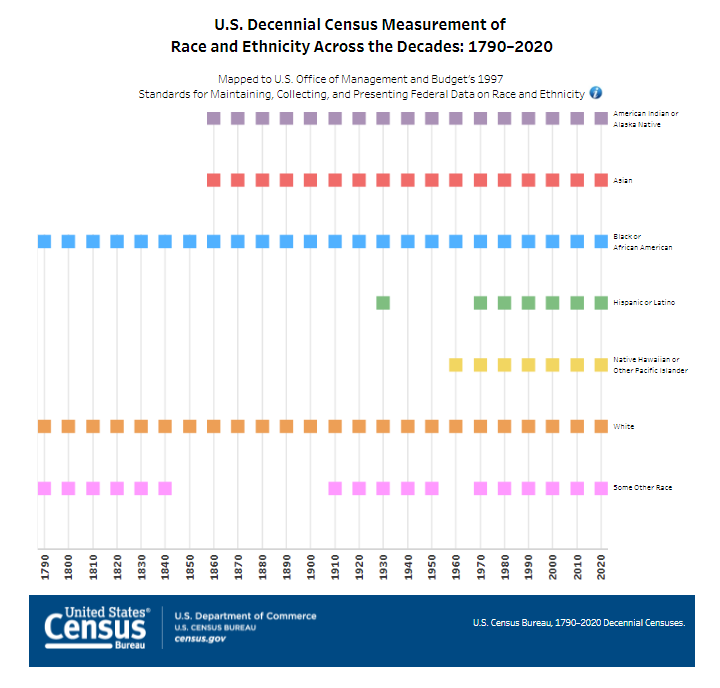
Data Viz: Race and Ethnicity Across the Decades: 1790-2020


Data Viz: Race and Ethnicity Across the Decades: 1790-2020

Race and Ethnicity Across Decades

Check out our interactive infographic timeline to see the race and ethnicity categories used in the U.S. Decennial Census from 1790-2020. 

Learn More

Tuesday, October 20, 2020

Celebrate World Statistics Day


October 20, 2020 is #WorldStatisticsDay. Celebrate the impactful stats and innovative data solutions that drive decision-making with the @USCensusBureau. Explore #DataTools on the #WorldStatsDay page: census.gov/WSD2020 #StatsDay2020 

Every 5 years, #WorldStatisticsDay is celebrated around the world to recognize the value of statistical systems.

Wednesday, August 12, 2020

US Census Bureau's Webinar Today: Tips and Tricks to Access Data on Ancestry and Foreign-born Populations

Webinar Today: Tips and Tricks to Access Data on Ancestry and Foreign-born Populations

Registered United States Census Bureau Logo

Where We Come From: Tips and Tricks to Access Data on Ancestry and Foreign-born Populations

Discover the best way to access demographic, socioeconomic and housing data about foreign-born populations using data.census.gov. Learn about how we collect data, regardless of legal status, unauthorized migrants are included in Census Bureau estimates of the total foreign-born population. In this webinar, we will also explore topics such as nativity, ancestry, language, and more.

Join Us

The U.S. Census Bureau uses the term foreign-born to refer to anyone who is not a U.S. citizen at birth. This includes naturalized U.S. citizens, lawful permanent residents, temporary migrants, humanitarian migrants, and unauthorized migrants.

Gray Divider
Wednesday, August 12, 2020
  • Date: Today
  • Time: 2:00 p.m. ET
  • Dial In: 888-282-1677
  • Passcode: 5537411
  • Link: Log In Details

Help us spread the word about Census Academy. Share this on social media or forward it to a friend.

Share This

Additional Webinars Coming Soon

US Census Bureau Webinar Today: Introduction to the American Community Survey

Webinar Today: Introduction to the American Community Survey

Registered United States Census Bureau Logo

Introduction to the American Community Survey

Discover the detailed social, demographic, economic, and housing statistics that the American Community Survey (ACS) provides for every community every year. 

Join Us

You will learn about basics of the yearly estimates and datasets produced from the ACS, resources available on our website, and how to access ACS data products through a variety of tools.

Gray Divider
Wednesday, August 12, 2020
  • Date: Today
  • Time: 2:00 p.m. ET
  • Dial In: 888-790-3585
  • Passcode: 5117145
  • Link: Log In Details

Event Password: acs (If required, this password is only for users who join from a WebEx application or mobile app.)

Help us spread the word about Census Academy. Share this on social media or forward it to a friend.

Share This

Additional Webinars Coming Soon

Monday, August 10, 2020

Tips and Tricks to Access Data on Ancestry and Foreign-born Populations

Coming Next Week: Tips and Tricks to Access Data on Ancestry and Foreign-born Populations

Registered United States Census Bureau Logo

Where We Come From: Tips and Tricks to Access Data on Ancestry and Foreign-born Populations

Discover the best way to access demographic, socioeconomic and housing data about foreign-born populations using data.census.gov. Learn about how we collect data, regardless of legal status, unauthorized migrants are included in Census Bureau estimates of the total foreign-born population. In this webinar, we will also explore topics such as nativity, ancestry, language, and more.

Join Us

The U.S. Census Bureau uses the term foreign-born to refer to anyone who is not a U.S. citizen at birth. This includes naturalized U.S. citizens, lawful permanent residents, temporary migrants, humanitarian migrants, and unauthorized migrants.

Gray Divider
Wednesday, August 12, 2020
  • Date: August 12
  • Time: 2:00 p.m. ET
  • Dial In: 888-282-1677
  • Passcode: 5537411
  • Link: Log In Details

Wednesday, August 05, 2020

Exploring Census Data Webinar Series: New Businesses Statistics

Registered United States Census Bureau Logo

Exploring Census Data Webinar Series: New Businesses Statistics

Census Bureau’s subject matter experts will provide practical ways to use our business data from economic programs to dive into business expansions and contractions.

Join Us

The session will explore several dimensions of births and deaths of businesses with highlights to include demographic components of new businesses. The webinar includes a segment on available resources and data tools with the opportunity for questions and answers.

Gray Divider
Tuesday, August 11, 2020
  • Date: August 11
  • Time: 2:00 p.m. ET
  • Dial In: 888-989-6421
  • Passcode: 9494158
  • Link: Log In Details

Event Password: census (If required, this password is only for users who join from a WebEx application or mobile app.)

Monday, July 11, 2016

Most common age in U.S., by race and ethnicity

Using Census data, the Pew Research Center has created a histogram showing the most common age for white (55 years), black (24 years), Hispanic (8 years), and Asian (33 years) people in the United States. The full report explaining the histogram is also available.

Tuesday, March 15, 2016

Census Bureau Irish Statistics for St. Patrick's Day

The Census Bureau has a Facts for Features section on its web page that celebrates holidays and seasonal/special events. The page that is dedicated to celebrating St. Patrick's Day has a wide variety of statistics ranging from the educational and income status of Irish Americans to beef and cabbage production. Celebrate St. Patrick's Day (March 17) with fun facts.

Thursday, January 21, 2016

Census Bureau Report on Child Support

On January 19, 2016 the Census Bureau released a report entitled Custodial Mothers and Fathers and Their Child Support: 2013 containing data from the Child Support Supplement to the April 2014 Current Population Survey. The report "presents a snapshot of custodial parents and child support payments — either legal or informal — that were reported as received from noncustodial parents living outside the home." Highlights include:

  • About half (48.7 percent) of all custodial parents had either legal or informal child support agreements, and custodial mothers were more likely to have agreements (52.3 percent) than custodial fathers (31.4 percent).
  • The aggregate amount of child support due in 2013 was $32.9 billion, a decrease of $14.0 billion from a decade earlier when adjusted to 2013 dollars.
  • About 68.5 percent of the $32.9 billion in child support due in 2013 was reported as received, averaging $3,950 per year per custodial parent who was due support.

Wednesday, December 23, 2015

State Population Estimates

What states are the most populous? Find out using the December 2015 release from the  Census Bureau entitled "Annual Estimates of the Resident Population for the United States, Regions, States, and Puerto Rice: April 1, 2010 to July 1, 2015 (NST-EST2015-01." The publication includes the following note:

The estimates are based on the 2010 Census and reflect changes to the April 1, 2010 population due to the Count Question Resolution program and geographic program revisions. See Geographic Terms and Definitions at http://www.census.gov/popest/about/geo/terms.html for a list of the states that are included in each region.  All geographic boundaries for the 2015 population estimates series except statistical area delineations are as of January 1, 2015.  For population estimates methodology statements, see https://www.census.gov/popest/methodology/index.htmlhttps://www.census.gov/popest/methodology/index.html.

Wednesday, February 19, 2014

New Website for Census Bureau

On Feb. 19, 2014 the Census Bureau released a beta version of its new census.gov website, beta.census.gov . The newly designed website is scheduled to become available in mid-March.
The website will feature the following new statistical digital tools:
  • Internet response — The Census Bureau offers Internet response for many of its surveys, including the American Community Survey. The Internet option makes responding to surveys more convenient, conducting surveys more cost-effective and America’s statistics more accessible on digital and mobile devices.
  • dwellr mobile app — The newest app from the Census Bureau allows people to compare their preferences to find 25 “ideal” dwelling places, based on statistics from the American Community Survey. Users can check their current locations and share their places on Facebook and Twitter.
  • Census Explorer — The newest mapping tool from the Census Bureau provides a look at eight topics from the American Community Survey and how they have changed since the 1990 and 2000 censuses.
  • Open data application programming interface — The Census API lets developers customize Census Bureau statistics in their Web or mobile apps. The API offers data from the American Community Survey and the 2010, 2000 and 1990 censuses.
  • America’s Economy mobile app — The app provides real-time updates for 20 key economic indicators from the Census Bureau, Bureau of Labor Statistics and Bureau of Economic Analysis.