Tuesday, September 21, 2021

Finding 2020 Census Redistricting Data


Redistricting Data, P.L. 94-171, was made available to the public on data.census.gov, on September 16, 2021. This includes data for all states, the District of Columbia, and Puerto Rico, down to the census block level. In this webinar session, participants will enjoy a live demonstration of various examples on how to navigate the data.census.gov platform to access and download 2020 Census redistricting data. We will also provide participants with links on where to find additional resources and technical documentation about Redistricting Data.

Wednesday, August 25, 2021

State-by-State Visualizations of Key Demographic Trends From the 2020 Census


America Counts Releases State Data Profiles

America Counts State Profiles

State-by-State Visualizations of Key Demographic Trends From the 2020 Census

The U.S. Census Bureau today released 52 individual data profiles on America Counts highlighting the recent 2020 Census Redistricting Data (Public Law 94-171) Summary File release.

These sharable data-rich state profiles are available for all 50 states, the District of Columbia and Puerto Rico, and feature data visualizations that include population, housing, race, ethnicity, diversity and age data. Each profile provides key demographic characteristics of each state and county on one page.

State Profiles

America Counts regularly features stories on various topics such as families, housing, employment, business, education, the economy, emergency management, and population. Sign up for the America Counts newsletter to receive the latest stories on Census Bureau statistics.

Wednesday, August 04, 2021

Copyright Office Announces Open Application Period for Ringer Fellowships


Copyright Office Announces Open Application Period for Ringer Fellowships

NewsNet 910
July 30, 2021

The Copyright Office is now accepting applications for the Barbara A. Ringer Copyright Honors Program. This fellowship, which runs eighteen to twenty-four months, was created for attorneys in the initial stages of their careers who demonstrate exceptional ability and interest in copyright law. Ringer Fellows work closely with senior attorneys and others in the Office of the General Counsel, the Office of Policy and International Affairs, the Office of the Register, and the Office of Registration Policy and Practice on a range of copyright-related law and policy matters. Ringer Fellows serve as full-time federal employees for the term of their fellowships and are eligible for salary and benefits as permitted under federal law.

Additional details about the Ringer Fellowship, including the application process, can be found on the Barbara A. Ringer Copyright Honors Program website. Applications will be accepted through December 31, 2021.

Update and Resources for 2020 ACS Data Release

 The Census Bureau announced that they will not be releasing their standard 2020 ACS 1-year data products in September as planned due to the impact of the pandemic on data quality. Instead, they will be releasing a set of experimental estimates from the 1-year data. They have created several resources to help data users prepare for this change:

*            A press kit includes a PDF version of yesterday's webinar, background materials 
explaining what experimental data products are, and information about the Census Bureau's 
statistical quality standards. A recording of the webinar should be available by late Monday.
*            A revised 2020 ACS release schedule includes the complete schedule with new 
planned release dates.
*            The ACS Resource Hub flyer and 2020 ACS 1-Year Estimates: What You Need to Know
flyer provide more information.

2020 Census Blog Series: How We Complete the Census When Characteristics are Missing


2020 Census Blog Series: How We Complete the Census When Demographic and Housing Characteristics Are Missing

By Roberto Ramirez, assistant division chief, Special Population Statistics, Population Division and Christine Borman, statistician demographer, Count Review Office, Population Division, U.S. Census Bureau

Although we strive to obtain all demographic and housing data from every individual in the census, missing data are part of every census process. Fortunately, we have long-established procedures we’ve used in previous censuses and surveys to fill in these missing pieces.

As you’ll see in this latest blog, the process is complex but is a reflection of the extensive standard statistical methodology we use to account for missing or conflicting data.

Read More

Census Bureau to Host Informational Webinar in Advance of 2020 Census Redistricting Data Release


Census Bureau to Host Informational Webinar in Advance of 2020 Census Redistricting Data Release

The U.S. Census Bureau will host a webinar on Thursday, Aug. 5 at 1 p.m. EDT ahead of the release of 2020 Census P.L. 94-171 Redistricting Data. The webinar will include instructions on how to access redistricting data; information on improvements to the race and ethnicity questions design, processing, and coding; along with a presentation on how the Census Bureau is measuring diversity in the United States.

Learn More

Who:

  • James Whitehorne, chief, Redistricting and Voting Rights Data Office, Census Bureau
  • Matthew Spence, senior advisor for Special Population Statistics and Disclosure Avoidance, Population Division, Census Bureau
  • Eric Jensen, senior technical expert for Demographic Analysis, Population Division, Census Bureau
  • Rachel Marks, chief, Racial Statistics Branch, Population Division, Census Bureau
  • Michael C. Cook, Sr., chief, Public Information Office, Census Bureau (moderator)

Access:

  • Join the webinar.
  • Audio access: 888-847-6588, passcode 7727651

The webinar will be recorded and available for viewing in the 2020 Census Redistricting Files Press Kit. 

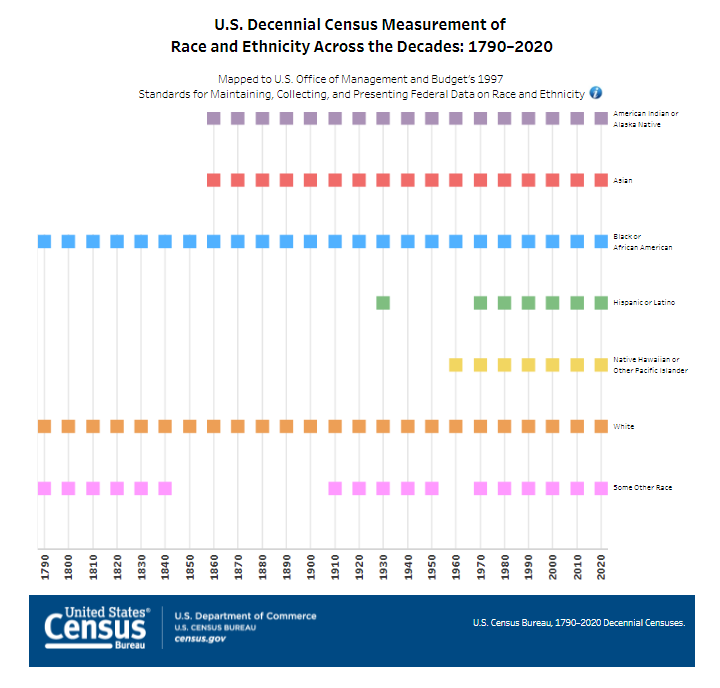
Data Viz: Race and Ethnicity Across the Decades: 1790-2020


Data Viz: Race and Ethnicity Across the Decades: 1790-2020

Race and Ethnicity Across Decades

Check out our interactive infographic timeline to see the race and ethnicity categories used in the U.S. Decennial Census from 1790-2020. 

Learn More