Showing posts with label 2020 census. Show all posts

Wednesday, August 25, 2021

State-by-State Visualizations of Key Demographic Trends From the 2020 Census


America Counts Releases State Data Profiles

America Counts State Profiles

State-by-State Visualizations of Key Demographic Trends From the 2020 Census

The U.S. Census Bureau today released 52 individual data profiles on America Counts highlighting the recent 2020 Census Redistricting Data (Public Law 94-171) Summary File release.

These sharable data-rich state profiles are available for all 50 states, the District of Columbia and Puerto Rico, and feature data visualizations that include population, housing, race, ethnicity, diversity and age data. Each profile provides key demographic characteristics of each state and county on one page.

State Profiles

America Counts regularly features stories on various topics such as families, housing, employment, business, education, the economy, emergency management, and population. Sign up for the America Counts newsletter to receive the latest stories on Census Bureau statistics.

Wednesday, August 04, 2021

2020 Census Blog Series: How We Complete the Census When Characteristics are Missing


2020 Census Blog Series: How We Complete the Census When Demographic and Housing Characteristics Are Missing

By Roberto Ramirez, assistant division chief, Special Population Statistics, Population Division and Christine Borman, statistician demographer, Count Review Office, Population Division, U.S. Census Bureau

Although we strive to obtain all demographic and housing data from every individual in the census, missing data are part of every census process. Fortunately, we have long-established procedures we’ve used in previous censuses and surveys to fill in these missing pieces.

As you’ll see in this latest blog, the process is complex but is a reflection of the extensive standard statistical methodology we use to account for missing or conflicting data.

Read More

Census Bureau to Host Informational Webinar in Advance of 2020 Census Redistricting Data Release


Census Bureau to Host Informational Webinar in Advance of 2020 Census Redistricting Data Release

The U.S. Census Bureau will host a webinar on Thursday, Aug. 5 at 1 p.m. EDT ahead of the release of 2020 Census P.L. 94-171 Redistricting Data. The webinar will include instructions on how to access redistricting data; information on improvements to the race and ethnicity questions design, processing, and coding; along with a presentation on how the Census Bureau is measuring diversity in the United States.

Learn More

Who:

  • James Whitehorne, chief, Redistricting and Voting Rights Data Office, Census Bureau
  • Matthew Spence, senior advisor for Special Population Statistics and Disclosure Avoidance, Population Division, Census Bureau
  • Eric Jensen, senior technical expert for Demographic Analysis, Population Division, Census Bureau
  • Rachel Marks, chief, Racial Statistics Branch, Population Division, Census Bureau
  • Michael C. Cook, Sr., chief, Public Information Office, Census Bureau (moderator)

Access:

  • Join the webinar.
  • Audio access: 888-847-6588, passcode 7727651

The webinar will be recorded and available for viewing in the 2020 Census Redistricting Files Press Kit. 

Improvements to the 2020 Census Race and Hispanic Origin Question Designs, Data Processing, and Coding Procedures


Improvements to the 2020 Census Race and Hispanic Origin Question Designs, Data Processing, and Coding Procedures

Written By Rachel Marks, chief, Racial Statistics Branch, Population Division and Merarys Rios-Vargas, chief, Ethnicity and Ancestry Branch, Population Division

The U.S. Census Bureau has collected data on race since the first census in 1790 and on Hispanic or Latino origin (referred to as Hispanic origin in this blog) since the 1970 Census. How these topics are measured, and statistics on them are collected and coded, has changed nearly every decade throughout the history of the census, reflecting social, political and economic factors.

This blog discusses how we improved the census questions on race and Hispanic origin, also known as ethnicity, between 2010 and 2020. These changes provide important context as we prepare to release the 2020 Census Redistricting Data (Public Law 94-171) Summary File.

Read More

United States Census 2020 Measuring Racial and Ethnic Diversity for the 2020 Census


The Census Bureau will release measures of diversity to present the complexity of 2020 Census results compared to 2010 Census results.

Measuring Racial and Ethnic Diversity for the 2020 Census

Measuring Racial and Ethnic Diversity

Written By Eric Jensen, senior technical expert for Demographic Analysis; Nicholas Jones, director and senior advisor for Race and Ethnicity Research and Outreach; Kimberly Orozco, demographic statistician; Lauren Medina, demographic statistician; Marc Perry, senior demographer; Ben Bolender, senior advisor; and Karen Battle, chief, Population Division

Later this month, the U.S. Census Bureau plans to release the first results from the 2020 Census on race and ethnicity. These data will provide a snapshot of the racial and ethnic composition and diversity of the U.S. population as of April 1, 2020.

We will release the following measures of diversity to clearly present and analyze the complexity of the 2020 Census results compared to the 2010 Census results:

  • Diversity Index.
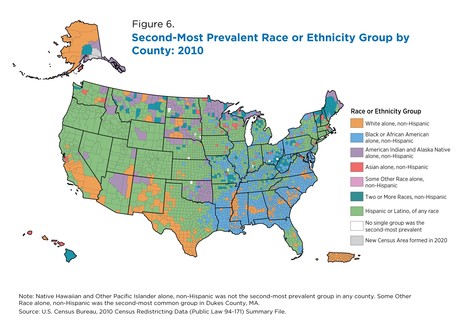
  • Prevalence rankings and diffusion score.
  • Prevalence maps.

In this blog, we provide a preview of these measures and explain what each can tell you about the nation’s racial and ethnic composition and diversity.

Read More

Tuesday, August 11, 2020

Door-to-Door Visits Begin Nationwide for 2020 Census

Door-to-Door Visits Begin Nationwide for 2020 Census

Door-to-Door Visits Begin Nationwide for 2020 Census

Census Takers to Follow Up With About 56 Million Households Nationwide

AUG. 11, 2020 — This week, the U.S. Census Bureau began following up with households nationwide that have not yet responded to the 2020 Census. Based on the current self-response rate of 63.3%, the Census Bureau estimates it will need to visit about 56 million addresses to collect responses in person. Up to 500,000 census takers across the country will go door to door to assist people in responding to the 2020 Census.

Learn More

Census takers began following up with households on July 16 in a limited number of areas and added additional areas each week thereafter. Starting Aug. 9, all remaining offices began following up with households nationwide. Census takers have completed training on social distancing and safety protocols, will follow local public health guidelines, and will be required to wear a face mask when conducting follow-up visits.

“America has answered the call and most households responded to the census online, by phone or by mail,” said Census Bureau Director Dr. Steven Dillingham. “To ensure a complete and accurate count, we must now go door to door to count all of the households we have not heard back from. During this phase, you can still self-respond online (at 2020census.gov), by phone (at 844-330-2020), or by mailing your completed questionnaire.”

The Nonresponse Followup (NRFU) operation is the final stage of conducting the once-a-decade population count of everyone living in the United States. Households can still respond now by responding online at 2020census.gov, by phone at 844-330-2020, or by completing and mailing back the paper questionnaire they received. Households can respond online or by phone in one of 13 languages and find assistance in many more. Those that respond will not need to be visited to obtain their census response.

What Households Can Expect

In most cases, census workers will make up to six attempts at each housing unit address to count possible residents. This includes leaving notification of the attempted visit on the door. The notification will include reminder information on how to respond online, by paper or by phone. In addition, census workers may try to reach the household by phone to conduct the interview.

Census takers will go to great lengths to ensure that no one is missed in the census. After exhausting their efforts to do an in-person interview with a resident of an occupied housing unit, they will seek out proxy sources — a neighbor, a rental agent, a building manager or some other knowledgeable person familiar with the housing unit — to obtain as much basic information about the occupants as they can.

Census takers are hired from local communities. All census takers speak English, and many are bilingual. If a census taker does not speak the householder’s language, the household may request a return visit from a census taker who does. Census takers will also have materials on hand to help identify the household’s language.

How to Identify Census Takers

Census takers can be easily identified by a valid government ID badge with their photograph, a U.S. Department of Commerce watermark, and an expiration date on the badge. To confirm a census taker’s identity, the public may contact their regional census center to speak with a Census Bureau representative.

The Census Bureau Will Follow Up With Some Households by Phone

In order to minimize the need to send census takers to households in person, the Census Bureau is training census takers to follow up with households by phone. Using information provided to the Census Bureau and third-party purchased data, the Census Bureau has a strong contact list for both landlines and cellphones assigned to houses on the Census Bureau’s address list. These phone calls will enable the Census Bureau to have maximum flexibility for conducting field operations, and is one more method that census takers can use to reach nonresponding households. Phone calls will be used on an as-needed basis and when in-person contact attempts have not resulted in an interview. If a voicemail is available, the census taker will leave a message asking the household to call one of the Census Bureau’s call centers.

Census Response Representatives to Visit Low-Responding Areas

The Mobile Questionnaire Assistance (MQA) program will continue through Sept. 30. This is a separate activity from census takers going door to door. MQA representatives are in open, public places in the lowest-responding areas of the nation to encourage people to respond to the 2020 Census. These locations are where people naturally visit when leaving home and can be used to help increase self-response rates. MQA is part of the Census Bureau’s final push to encourage people to complete the 2020 Census.

About the 2020 Census

The U.S. Constitution mandates a census of the population every 10 years. The goal of the 2020 Census is to count everyone who lives in the United States on April 1, 2020 (Census Day). Census statistics are used to determine the number of seats each state holds in the U.S. House of Representatives and inform how billions of dollars in federal funds will be allocated by state, local and federal lawmakers annually for the next 10 years. 

For more information, visit 2020census.gov.

No news release associated with this announcement. Tip Sheet only. 

Friday, May 29, 2020

2020 Census Self Response Rate

2020 Census

Self-Response Rate by state, county, city, or Congressional District
https://2020census.gov/en/response-rates.html

55% Texas State, 51.1% Houston (05/29/2020)

Thursday, March 12, 2020

Regardless of Coronavirus, 2020 Census is still coming!

2020 Census email invitations should arrive any time between today March 12 and March 20. Keep an eye on it. Once you receive it, take it as soon as possible to avoid census taker knock at your door later. This is the first time in the history you have three convenient ways to respond: web, phone, or paper. The Census Bureau estimates that it will take ten minutes per person in a household to complete the Census form. Once you are done, educate and engage someone else take it too.

Resources for more information:

Friday, January 11, 2019

GPO Awards New Contract for 2020 U.S. Census Materials

The U.S. Government Publishing Office (GPO) has awarded the contract for 2020 Census printing materials and mailing services to R.R. Donnelley & Sons Company (RRD) following a competitive procurement process. RRD is a Chicago based company, and production will take place at several of its facilities across the country. The contract was awarded for $114,557,201.27, which is well within the U.S. Census Bureau’s budget. It covers the production of materials that will help the public respond to the 2020 Census, including questionnaires, letters, inserts, postcards, and envelopes. GPO and U.S. Census Bureau employees will conduct quality control and testing throughout the contract period.
GPO initially made an award in November 2017, but that contract was terminated following a settlement between the Department of Justice and the contractor in July 2018.
“GPO is committed to working with the U.S. Census Bureau on the successful production of the 2020 Census,” said GPO Acting Deputy Director Herbert H. Jackson, Jr. “This is another example of how our long-standing print procurement program meets the printing needs of Federal agencies through GPO’s partnerships with private-sector companies.”
GPO’s nationwide print procurement program provides significant economic opportunities for private sector companies to expand their business by providing services to Federal agency customers on a national level. Nearly 75% of all printing ordered by Federal agencies from GPO is performed by private sector firms working under contract with the agency. GPO typically awards contracts to about 700 printing contractors a year. Nearly 10,000 companies are registered to do business with the agency, using GPO as their one-stop shop for print contract opportunities. GPO's long-standing relationship with the private sector dates back to the 1940s.